
Gravity Debate: Newton’s Force vs. Einstein’s Curvature
Gravity is a natural phenomenon by which all things with mass or energy are attracted to each other. Gravity is explained differently by Isaac Newton and Albert Einstein. Einstein ultimately defined gravity more accurately than Newton, but Newton’s model remains practical for everyday use.
Newton saw gravity as a force acting at a distance, while Einstein revealed it as the curvature of spacetime caused by mass and energy.
Newton's law accurately explains planetary motion and everyday physics. Einstein's General Theory of Relativity better explains black holes, gravitational waves and extreme cosmic events. Today, scientists use Newton’s model for practical calculations and Einstein’s theory for high-precision astrophysics.
Here are some important things you need to know about gravity.
 |
| What is Gravity? |
Everything Thing You Need To Know About Gravity
We all know the fact that Gravity is responsible for why objects attract to each other, why we stick to the surface of the earth and why planets orbit around the sun.
There are four fundamental forces that exist in our universe: Electromagnetic force, gravitational force followed by strong and weak nuclear force. These four are the fundamental forces responsible for any force taking place in the universe.
- Strong Nuclear Force: The strongest force, acting over short ranges (subatomic) to bind protons and neutrons together within atomic nuclei.
- Electromagnetic Force: Governs interactions between electrically charged particles, combining electricity and magnetism. It is responsible for atomic structure, chemistry, and solid objects' resistance.
- Weak Nuclear Force: Crucial for nuclear interactions, specifically acting in radioactive decay and enabling nuclear fusion in stars.
- Gravitational Force: The weakest force, yet acts over infinite ranges to attract bodies with mass, governing planetary orbits and large-scale structures.
But the real question is,
Is gravity a force?
Let's explore Newton’s force vs. Einstein’s spacetime curvature—discover who defined gravity best, from everyday physics to cosmic phenomena.
Go into the depth of this and first understand its history of discovery.
The Discovery of Gravity
Starting from the very start, in the 4th century BC, Aristotle, a Greek philosopher said each and every object in the universe has a natural tendency to fall to the center of the universe. He said, there is no effect or motion without any cause taking place. Also at that time the Geocentric model was known to be correct, so his idea was widely accepted.
But after Nicolas Copernicus found and concluded that it would make sense if the Sun would be at the center of the planets.
“Earth is not the center of the universe but planets revolve around the sun,” as per Nicolas Copernicus. He introduced the heliocentric model to the world.
At first, many people were against this idea. His ideas were fiercely opposed by the Roman Catholic Church because they displaced Earth from the center, and that was seen as both a demotion for human beings and contrary to the teachings of Aristotle.
But then, after his death, people tend to believe his proposed ideas as many great scholars supported the heliocentric model. But yet no one explained the phenomena of gravity.
In 1687, Sir Issac Newton published the theory of gravity in a treatise, Philosophiæ Naturalis Principia Mathematica. He explained that every object in the universe attracts others with a force, that is nothing but gravitational force. He also formulated a mathematical expression of gravity in the book.
Newton's Law of Universal Gravitation
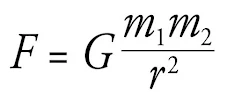
F=GMm/r²
where,- F is the gravitational force G is gravitational constant M is the mass of Earth m is the mass of object and r is the distance between two objects.
Gravitational Constant
Although Newton gave the gravitational formula. He theorized the law and gave mathematical equations. But he did not calculate the universal gravitational constant.
Between 1797-1798, a scientist named Henry Cavendish was the one who experimented for the first time and calculated the value of gravitational constant through an experiment in the laboratory.
The gravitational constant was found to have a value of
6.67× 10⁻¹¹m3kg−1s−2.
But soon, it was realized that there was something that was missing in gravitational law given by Sir Issac Newton. The law may explain many things in our solar system but there were a few problems it was not able to explain.
One of them was the mercury orbit problem. If a law or a theory is not able to explain a thing then it is not directly discarded but needs some modification or a new theory is required. This was the case in Newton’s law of gravitation.
Problem with the Newton’s Law of Gravitation
The law of gravitation is able to give an explanation of why two objects attract each other. It is able to give a numerical value to the force that object is getting attracted to any other body.
With the help of this law, we were successful in discovering a planet, Uranus.But it is unable to explain many other problems.
One of the problems it could not explain is the orbit of Mercury. The calculation predicted to that of actually calculated didn’t match. It also failed to explain the basic principle behind acceleration and gravity.
Newton proposed how gravity works and how we can calculate it but he couldn’t explain the reason behind gravity.
Einstein’s General Theory of Relativity
In 1916, Albert Einstein published a paper on the General theory of relativity which explained the very basic idea of space, time, gravity and acceleration.
His discovery abolished the established notions about space and time replacing Newton’s law of gravitation.
According to Einstein, Gravity is the result of space-time curvature. He explained gravity through space-time.
Understanding the Space and Time
Einstein proposed in his paper that space and time are not absolute. They are relative to each other. Space cannot be explained without the time and vice-versa.
 |
| Image credit: Nasa.gov |
Let us take an example to understand what space-time means and how it gives rise to gravity.
Imagine a fabric several to be stretched from all sides as shown above. If you put a metallic ball from above it would bend the central part of the fabric. Right?
But just think why would it bend?
It would bend due to its heavy mass.
Now imagine if you drop other balls but this time these were to be smaller and lighter than the one initially dropped. What would you think would happen?
You would see the lighter and smaller balls revolving around the heavy metallic ball.
This is how our universe also works. Every object is inside this space-time. And for every object, it behaves like a stretched fabric.
This is the reason why planets revolve around the Sun. And why the moon revolves around the planet. Because the Sun is heavy it makes a curve around it. Due to which planets around it revolve, the same way as you just see in the above diagram.
Warping of Space-Time
The bending of fabric which is made due to the heavy mass of an object is the curvature through which other lighter objects revolve around it. In more scientific terms, we call this curvature as warping of space-time.
And this warping of space-time is responsible for gravity. That is why Einstein described gravity to be a geometry, not a force.
Gravity is Not a Force!
Aforesaid, gravity is a consequence of curvature made in space-time. At first, it was hard to believe that it is not a force but a phenomenon. But when the general theory of relativity got verified by many experiments, it is then believed that gravity is not fundamental, it is a consequence.
Newton vs. Einstein: Who Defined Gravity Best?
Newton’s theory of gravity was revolutionary, offering a clear mathematical law that explained planetary motion and everyday phenomena. His inverse-square law remains a cornerstone of classical physics and is still taught because of its simplicity and practical accuracy in most contexts.
However, Newton’s idea of gravity as an instantaneous force acting at a distance left unanswered questions, especially at cosmic scales.
Einstein’s general relativity redefined gravity as the curvature of spacetime, a geometric property of the universe itself. This model explained phenomena Newton could not, such as the bending of light around stars, time dilation near massive bodies, and the existence of gravitational waves—later confirmed by direct observation.
Einstein’s theory also underpins modern astrophysics, cosmology, and technologies like GPS, which require relativistic corrections to remain accurate.
Newton defined gravity best for everyday life, while Einstein defined it best for the universe. Newton’s law is practical and accessible, but Einstein’s relativity is the deeper, more accurate description of reality.
They represent a progression in human understanding: Newton gave us the foundation, and Einstein expanded it to the cosmos.
How Spacetime Curvature Controls the Universe
Einstein’s theory of general relativity showed that gravity is not a force pulling objects together, but the curvature of spacetime created by mass and energy.
Massive bodies like stars, planets, and black holes bend the fabric of spacetime, and this curvature directs how objects move.
When Earth orbits the Sun, it is not being “pulled” by a force in the Newtonian sense. Instead, the Sun’s mass curves spacetime, and Earth follows the curved path—like a ball rolling along a warped surface.
Light also follows these curves, which explains phenomena such as gravitational lensing, where distant galaxies appear magnified or distorted.
Spacetime curvature also controls the flow of time. Near massive objects, clocks tick more slowly due to gravitational time dilation. This effect is measurable with satellites and is essential for technologies like GPS.
On cosmic scales, spacetime curvature shapes the expansion of the universe, influences galaxy formation, and governs the motion of black holes and neutron stars.
Spacetime curvature is the invisible architecture of the cosmos. It determines the paths of planets, the bending of light, and the rhythm of time itself. Without it, the universe as we know it could not exist.
Read Also: Where is the Earth's Center of Gravity Located?
Conclusion
Gravity is the invisible force that keeps the universe together. At its core, gravity is the attraction between objects with mass. The more massive an object is, the stronger its gravitational pull. This is why Earth holds us firmly on the ground, while the Moon’s weaker gravity allows astronauts to bounce lightly on its surface.
Gravity has been an interesting topic that has been a topic of study from Aristotle time to now.
The search for what is gravity was already started in the 4th century BC but in the mid 16th century, Newton was the first who mentioned the term gravity in his treatise giving out a mathematical expression explaining it. He gave out the law of gravitation.
But soon it was realized that his law was unable to explain some problems in our solar system. The Mercury orbit problem was one of them. It was even not able to explain the cause behind gravity.
Albert Einstein with his general theory of relativity was the one who explained gravity through space and time. He concluded his idea by stating that gravity is not a force but a geometry made due to the warping of space-time.
His idea was hard to believe at first but then it got verified several times through experiments. GPS(Global-positioning-system) is a real-life example of that theory, which itself is proof that Einstein was not wrong.
In everyday life, Newton’s model works perfectly for engineering and science. But for cosmic events, Einstein’s theory gives the deeper truth. They show that gravity is both a practical law and a profound property of the universe—shaping motion, time, and the very structure of reality.
FAQs
1. What is gravity?
Gravity is the natural force that pulls objects toward each other. It keeps planets in orbit, causes objects to fall to Earth, and holds galaxies together. The more mass an object has, the stronger its gravity becomes. Gravity affects everything, from tiny particles to massive stars and black holes.2. Who discovered gravity?
Isaac Newton explained gravity after observing falling objects and planetary motion. He proposed that every object attracts every other object through a universal force. Later, Albert Einstein improved this idea by explaining gravity as the bending of space and time.3. Why do objects fall to Earth?
Objects fall because Earth’s gravity pulls them toward its center. Every object with mass experiences gravitational attraction. Earth is extremely massive, so its gravitational pull is strong enough to keep people, oceans, and the atmosphere attached to the planet instead of floating into space.
4. Is gravity the same everywhere?
Gravity changes slightly from place to place. It is stronger near massive objects and weaker farther away. For example, gravity on the Moon is much weaker than on Earth, which is why astronauts can jump higher there and objects weigh less compared to Earth.
5. How does gravity keep planets in orbit?
Gravity continuously pulls planets toward the Sun while the planets move forward through space. This balance creates stable orbits instead of collisions. Without gravity, planets would travel in straight lines and drift away from the solar system rather than circling the Sun.
6. Can gravity affect time?
Yes. According to Einstein’s theory of relativity, strong gravity can slow down time. Clocks near massive objects like black holes tick more slowly compared to clocks farther away. Scientists have confirmed this effect using precise atomic clocks and satellite technology such as GPS systems.
7. What is zero gravity?
Zero gravity does not mean gravity completely disappears. Astronauts in space still experience Earth’s gravity, but they are constantly falling around Earth while orbiting it. This creates a feeling of weightlessness, making people and objects appear to float inside spacecraft.
8. What are black holes?
Black holes are regions in space where gravity becomes extremely strong because massive stars collapse inward. Their gravitational pull is so powerful that even light cannot escape. Scientists study black holes to better understand gravity, space-time, and the extreme conditions of the universe.
9. Can humans create artificial gravity?
Scientists can simulate artificial gravity using rotation. When a spacecraft spins, centrifugal effects can push astronauts outward, creating gravity-like sensations. Researchers believe artificial gravity could help future long-term space missions by reducing muscle loss, bone weakening, and other health problems caused by weightlessness.
10. Why is gravity important for life?
Gravity makes life on Earth possible. It keeps the atmosphere stable, allows water to stay on the planet, and supports biological processes. Gravity also shapes stars, planets, and galaxies. Without gravity, Earth could not maintain the conditions necessary for human, animal, or plant life.
11. Why is gravity weaker in space?
Gravity becomes weaker with distance, but it never completely disappears. Astronauts in orbit are still under Earth’s gravity. However, because spacecraft and astronauts fall together around Earth, they experience continuous free fall, creating the sensation of floating or weightlessness inside the spacecraft.
12. What is the difference between mass and weight?
Mass measures how much matter an object contains and usually stays constant everywhere. Weight measures the force of gravity acting on that mass. On the Moon, a person’s mass remains the same, but their weight becomes much lower because lunar gravity is weaker.
13. Do light and gravity interact?
Yes. Gravity can bend the path of light, a phenomenon called gravitational lensing. Massive objects like galaxies and black holes curve space-time, forcing light to follow curved paths. Scientists use this effect to study distant stars, galaxies, and invisible matter across the universe.
14. What are gravitational waves?
Gravitational waves are ripples in space-time caused by powerful cosmic events such as colliding black holes or neutron stars. LIGO first detected them in 2015, confirming an important prediction made by Einstein’s theory of relativity nearly a century earlier.
15. Can gravity exist without matter?
Gravity is linked to mass and energy. According to modern physics, matter and energy curve space-time, creating gravitational effects. Without matter or energy, gravity would not exist. Scientists continue studying gravity because it remains one of the least understood fundamental forces in nature.